
Dormer installation: complete explanation
The installation of a dormer is often the most exciting day of the entire project for the resident. A crane drives into the street, roof tiles disappear from the roof, a hole appears, and hours later the dormer is ready — wind and watertight. However, behind that single day of placement lies weeks of preparation. This guide describes the entire installation cycle: from measuring and planning to hoisting, placement, watertight connections, and the final inspection upon delivery.
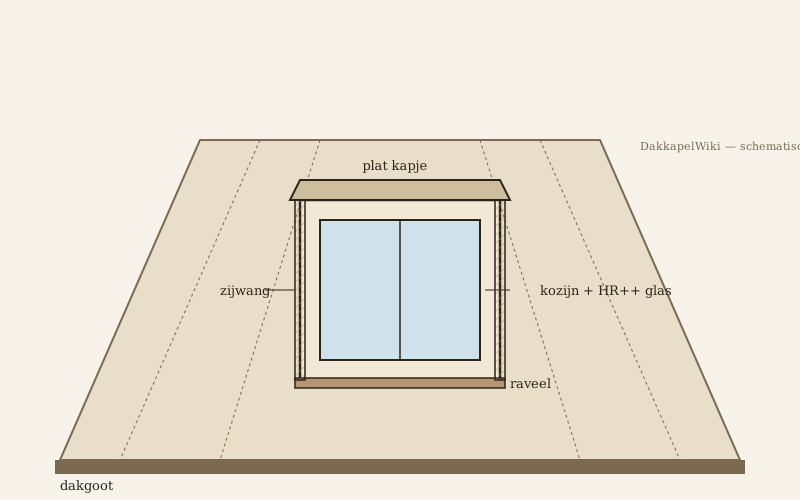
Preparation
The installation starts long before the day of placement. In the preparatory phase, the following happens:
- Measuring on location: roof pitch, roof width, position of rafters and any chimney or skylight.
- Design and dimensions aligned with planning permission regulations.
- Planning permission application where necessary.
- Production in the factory (prefab) or preparation of wood and materials (traditional).
- Planning the placement date, crane, transport, and possibly notifying the neighborhood.
- Access and parking prohibition requested from the municipality.
Good preparation determines 80% of the success of the installation day.
Measuring
During the measuring, a technician visits the location. They measure:
- Roof pitch with a spirit level or digital inclinometer.
- Roof width and the position of existing rafters or purlins.
- Height of the house relative to the street and crane position.
- Distance to ridge, roof base and sides for planning permission checks.
- Existing roofing (roof tile type, possibly lead flashing or zinc).
These measurements are translated into a factory drawing or a work order for the carpenter. The more accurate the measurement, the smaller the chance of adjustments on the day of placement.
Creating the roof opening
On the day of placement, work on the roof begins by clearing the roof opening.
1. Roof tiles are removed and stacked on scaffolding or in the garden. 2. Counter battens and tile battens are detached. 3. Any underlying membrane is cut open. 4. Rafters or purlins are sawn off at the marked location. 5. The trimmer framework is built up, possibly with reinforced rafters on both sides.
During this phase, the roof is usually covered with a tarpaulin or temporary screens to keep rainwater out. In bad weather, the work is postponed.
Hoisting and transport
With a prefab dormer, a crane arrives on the placement day: a truck-mounted crane for smaller sizes, or a mobile construction crane for large dormers or difficult locations. The dormer is delivered on a trailer, attached to the crane, and hoisted onto the roof in one go.
Safe hoisting
- The crane stands on a flat, stable surface with outriggers extended.
- The wind force is continuously measured.
- Above wind force 6 or during a thunderstorm, the operation is postponed.
- The construction opening is free of obstacles from above.
- No one is positioned under the hoisted load.
With a traditional dormer, hoisting is not applicable — material is delivered in separate parts via a ladder lift or by hand.
Placement on the roof
When the dormer hangs above the roof, it is lowered gently onto the sleeper joist or the trimmer framework. Two technicians on the roof guide the placement and align the dormer squarely and in line with the facade.
Immediately after, the dormer is secured with anchors and screws, and the structural/physical connection is prepared. Only then does the crane depart.
Watertight connections
The connection between the dormer and the existing roof is the most critical point of the entire installation. This determines whether the dormer remains leak-free for decades.
- Lead flashing is slid under the roof tiles and subsequently adhered to the side cheeks.
- Roof tiles are placed back, often with adapted corner tiles or slide-in tiles.
- The gutter is adjusted to the new shape if necessary.
- Rainwater drainage is connected to prevent accumulation.
- Vapor-permeable membrane around the connection is restored and taped off.
Interior finishing
On the inside, depending on the chosen execution (shell or complete), the finishing follows:
- Insulation checked and topped up.
- Vapor control layer taped at seams and penetrations.
- Plasterboard mounted against the frame.
- Plasterwork or a finishing layer.
- Window sill installed and finished.
- Trim applied around the window frame.
- Knee walls if desired.
For a shell delivery, these steps are carried out by the resident or a separate contractor.
Delivery and inspection
Upon delivery, the contractor walks through the installation together with the resident. Important points to check:
- Lead flashing neatly finished without folds or breaks.
- Roof tiles around the dormer correctly placed back.
- No tears or cracks in the cladding.
- Flatness of side cheeks and roof.
- Window frame neatly sealed and moving smoothly.
- Glass free of scratches.
- Rainwater drainage functioning.
- Warranty agreements on paper.
A completed inspection with photos prevents later discussions about the condition of the work.
Weather conditions
The weather largely determines what can and cannot be done on the day of placement.
- Rain during cutting open the roof is risky; short showers can be managed with tarpaulins, prolonged rain cannot.
- Wind force 6 or higher halts most crane operations.
- Thunderstorms immediately stop work due to lightning risks.
- Snow or frost requires extra care for material handling.
Good builders take this into account and schedule backup moments.
Common installation mistakes
- Poor lead flashing connections causing later leaks.
- Dormer not placed squarely, resulting in a skewed front facade.
- Roof tiles incompletely placed back, allowing blowing rain inside.
- Vapor control layer damaged during interior finishing.
- Rainwater drainage insufficient or incorrectly connected.
- Too little sealant on seams, leading to later draught complaints.
- No delivery inspection recorded with photos.
Comparison table
| Component | Prefab | Traditional |
|---|---|---|
| Placement duration of shell | Often 1 day | 5–10 working days |
| Crane needed? | Yes | Often not |
| Weather dependence hoisting | High | Lower (no hoisting moment) |
| Nuisance to the neighborhood | Short and intense | Longer and spread out |
| Connection to roof tiles | Separate work moment | Integrated into building process |
Frequently asked questions
Brief answers to frequently asked questions on this topic.
- How long does the installation of a prefab dormer take?
- The shell is usually made wind and watertight in one working day. Interior finishing takes a few extra days.
- Do I always need a crane?
- For a prefab dormer yes, for a traditional dormer usually not.
- What if the crane cannot reach it?
- Sometimes a larger crane with more reach helps. If that does not work, a traditional execution is an alternative.
- What happens in bad weather on the day of placement?
- In case of rain, work continues for as long as possible under tarpaulins. With wind force 6 or more or a thunderstorm, hoisting is usually postponed.
- How do I know the dormer is properly watertight?
- By visually inspecting the lead flashing connection and tile placement, and conducting a rain test or reviewing photos during the delivery inspection.
- Can I stay at home during the installation?
- You can, but expect noise and the attic being opened regularly. This can be impractical for small children.
- Does the street experience nuisance from the installation?
- On the day of placement, yes: a crane and truck are present, and a parking prohibition is necessary. After that, it is not too bad.
- When is the inside finished?
- With a complete execution, in the days following placement. With a shell delivery, that is the job of the resident or a finishing contractor.
- What if roof tiles break during installation?
- Good contractors replace them immediately. Make agreements about this beforehand.
- How do I properly check the delivery inspection?
- Walk through the checklist, take photos, and immediately record in writing any matters that still need repairing.
Summary
The installation of a dormer relies entirely on preparation: measuring, planning permission, planning, crane logistics, and weather assessment. On the day of placement, roof tiles are removed, the roof is cut open, the trimmer framework is made, and the dormer is installed — using a crane for prefab, or part by part for traditional. This is followed by the watertight connection to roof tiles and lead flashing, and ultimately the interior finishing. A thorough delivery inspection with a checklist and photos concludes the process.
Conclusion
The day of placement looks spectacular, but the real quality work occurs before and after: in the preparation, and in the meticulous connections between the dormer and the existing roof. Choosing a contractor based on craftsmanship rather than just price gives you the best chance of a dormer that functions flawlessly for decades.
Rules for planning permission, aesthetic guidelines, and typical construction vary by municipality. View the information for your city or see the full region overview.
- Noord-HollandDormer Amsterdam
- Zuid-HollandDormer Rotterdam
- Zuid-HollandDormer Den Haag
- UtrechtDormer Utrecht
- Noord-BrabantDormer Eindhoven
- GroningenDormer Groningen
- Noord-BrabantDormer Tilburg
- FlevolandDormer Almere
- Noord-BrabantDormer Breda
- GelderlandDormer Nijmegen
- GelderlandDormer Arnhem
- Noord-HollandDormer Haarlem