Materials for dormers: complete guide
The choice of materials largely determines what a dormer looks like, how often it needs maintenance, and how long it lasts. This applies to the exterior cladding (zinc, plastic, wood, Trespa) as well as the less visible components — insulation, foils, roofing, window frames, and glass. This guide discusses the common materials one by one, with their properties, strengths, and disadvantages. Intended to help you make an informed choice, not to recommend brands or suppliers.
Plastic
Plastic cladding usually consists of virtually maintenance-free panels or sheet material, often in a white or cream color. The lifespan is high (thirty years or more) and the surface hardly discolors. Plastic is the most popular choice for prefab dormers, mainly because the combination of price, lifespan, and appearance works for a large proportion of Dutch terraced houses.
Advantages and disadvantages
- Advantages: no painting, flat appearance, long lifespan, lightweight installation.
- Disadvantages: visually flat, limited color choice, scratch-sensitive with rough handling, does not always suit older buildings or monuments.
Wood
Wood has traditionally been the material for dormers and connects well architecturally with older homes. For the cladding, shiplap boards, profiled panels, or boards with opaque paint are used. Types like spruce, douglas fir, western red cedar, and Accoya are the most common.
Advantages and disadvantages
- Advantages: warm appearance, free choice of color and profiling, suits traditional architecture.
- Disadvantages: requires maintenance (repainting every five to ten years), can warp with poor ventilation, price-sensitive.
Polyester
Polyester is used for shell structures or as cladding on a wooden frame. A polyester shell is seamless, flat, and virtually maintenance-free. The lifespan is around thirty years.
Advantages and disadvantages
- Advantages: seamless, flat, freedom of shape in production, long lifespan.
- Disadvantages: difficult to repair invisibly if damaged, requires craftsmanship for connections.
Keralit
Keralit is a strong plastic sheet cladding that is applied as a shiplap-like profile. The material combines the sleek look of sheet material with the layered appearance of wooden shiplap boards.
Advantages and disadvantages
- Advantages: virtually maintenance-free, sleek appearance, long lifespan.
- Disadvantages: not always available in every desired color, more expensive than simple plastic panels.
Trespa
Trespa is a high-pressure laminate board often used on facades of commercial buildings, and increasingly on dormers. The material is colorfast, impact-resistant, and virtually maintenance-free.
Advantages and disadvantages
- Advantages: very high quality and sleek, long lifespan, large color choice.
- Disadvantages: price, sensitive to incorrect installation which can leave screw heads visible.
EPDM, bitumen and zinc on the roof
For the roof of a dormer, there are three main choices.
EPDM
EPDM is a synthetic rubber that is laid over the roof in one piece. Seamless, lightweight, and highly UV-resistant. Lifespan is often 30 years or more.
Bitumen
Bitumen roofing consists of one or two layers, applied with a burner. Proven technology with good creep performance, but heavier and more labor-intensive than EPDM.
Zinc
Zinc on the roof is more expensive but very long-lasting and provides a high-quality appearance. It is often combined with zinc side cheeks or a zinc fascia board.
Zinc and lead flashing at connections
Lead flashing or a similar metal is used for the connection between the dormer roof and the existing roof tiles. The lead flashing is slid under the tiles and creates a watertight connection to the side cheek. Incorrectly laid lead flashing is one of the most common causes of leakage in dormers.
Nowadays, there are also alternatives such as lead substitutes based on a rubber-metal mesh. For listed buildings or prominent locations, traditional lead flashing remains customary.
Window frames
Window frames for dormers are made of plastic, wood, or aluminum. The choice affects appearance, insulation value, and maintenance.
- Plastic window frame: low maintenance, well-insulated, widely available.
- Wooden window frame: warm, traditional, requires periodic painting.
- Aluminum window frame: slim profile, modern, higher price.
Within the frame, you can choose fixed glass, a casement window, or a tilt-and-turn window. A tilt-and-turn window with a ventilation position offers fine dust- and rain-resistant ventilation.
Glass: HR++, triple and fall safety
For dormers, HR++ is the standard basis. Triple glass insulates better, but weighs significantly more; check whether the frame and mounting can handle this.
- HR++ glass: double glazing with noble gas filling, U-value around 1,1 W/m²K.
- Triple glass: triple glazing, U-value around 0,5–0,7 W/m²K.
- Safety glass: laminated or toughened, less dangerous if broken.
- Fall-protection glass: mandatory when the parapet is below a certain height and you could fall through the glass.
Insulation
The three most commonly used insulation materials for dormers are PIR, glass wool, and rock wool.
- PIR: high insulation value per centimeter, ideal if space is limited. Rigid and easy to process.
- Glass wool: relatively inexpensive, flexible, good acoustic properties.
- Rock wool: similar to glass wool, more fire-resistant and somewhat firmer.
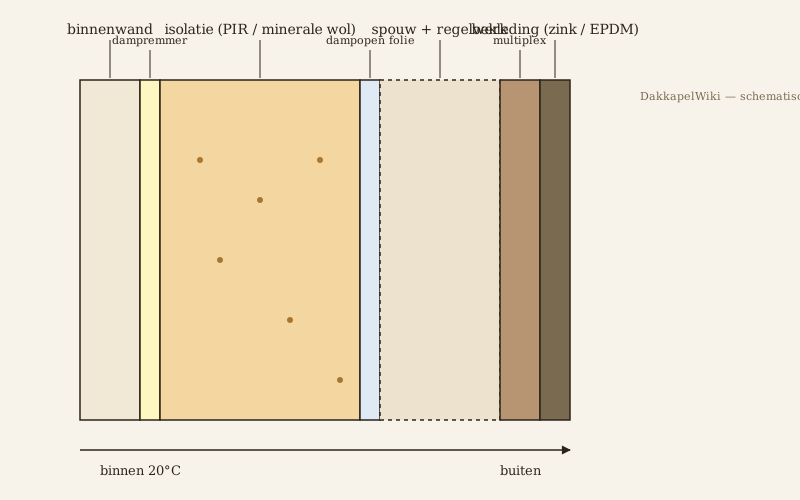
On the inside of the insulation belongs a vapor barrier foil, on the outside a vapor-permeable foil.
Comparison table
| Material | Maintenance | Lifespan | Appearance | Indicative price range |
|---|---|---|---|---|
| Plastic | Very low | 30+ years | Flat, modern | Low |
| Wood | Regular painting | 20–40 years | Traditional | Medium |
| Polyester | Very low | 25–40 years | Seamless flat | Medium |
| Keralit | Virtually none | 30+ years | Sleek, layered | Medium-high |
| Trespa | Virtually none | 30+ years | High-quality modern | High |
| Zinc | Virtually none | 50+ years | Timeless | High |
Frequently asked questions
Brief answers to frequently asked questions on this topic.
- Which material requires the least maintenance?
- Plastic, Keralit, Trespa, and zinc require virtually no maintenance. Wood requires periodic painting.
- What is the difference between EPDM and bitumen?
- EPDM is a seamless rubber layer, bitumen is applied in strips. Both perform well, but EPDM is lighter and faster to install.
- Is triple glass always better than HR++?
- In terms of building physics, yes, but the weight is a point of attention, and the added value can sometimes be disappointing in a dormer with limited glass area.
- When is fall-protection glass mandatory?
- When the parapet height is so low that someone could fall outside through the glass. A professional determines this based on specific dimensions.
- Which insulation provides the highest Rc-value per centimeter?
- PIR has a higher insulation value per centimeter than glass wool or rock wool.
- Is lead flashing still allowed to be used?
- Yes, but there are also lead substitutes based on a rubber-metal mesh that are sometimes preferred for environmental reasons.
- Which wood lasts the longest?
- Modified wood such as Accoya generally lasts the longest, especially when used in moist zones.
- Does plastic cladding discolor in the sun?
- With modern UV-resistant variants, discoloration is limited, but always noticeable to a small extent.
- Can I change materials later?
- Yes, but it is a major intervention that requires the cladding, sometimes insulation, and connections to be redone.
- Which material is suitable for monuments?
- Often wood or zinc, because these materials match the original appearance of the building.
Summary
Materials determine the appearance, maintenance, and lifespan of a dormer. For the exterior cladding, there is a wide range — from virtually maintenance-free plastic or zinc to warm wood requiring regular painting. The roof is finished with EPDM, bitumen, or zinc; connections with lead flashing or a lead substitute. Inside, PIR, glass wool, or rock wool provide insulation, in combination with vapor barrier and vapor-permeable foils.
Conclusion
Choose materials not only based on appearance, but also on maintenance, lifespan, and structural logic. A virtually maintenance-free plastic dormer is often fine for a terraced house; a richly detailed building usually deserves wood or zinc. Whatever you choose, the connections between materials — lead flashing, foils, sealant — are often more decisive for performance than the cladding itself.
Rules for planning permission, aesthetic guidelines, and typical construction vary by municipality. View the information for your city or see the full region overview.
- Noord-HollandDormer Amsterdam
- Zuid-HollandDormer Rotterdam
- Zuid-HollandDormer Den Haag
- UtrechtDormer Utrecht
- Noord-BrabantDormer Eindhoven
- GroningenDormer Groningen
- Noord-BrabantDormer Tilburg
- FlevolandDormer Almere
- Noord-BrabantDormer Breda
- GelderlandDormer Nijmegen
- GelderlandDormer Arnhem
- Noord-HollandDormer Haarlem