Traditional dormer: complete explanation
A traditional dormer is not made in a factory, but built entirely on the roof. A carpenter cuts the roof opening, installs trimmer joists, builds the side cheeks, places the window frame, and closes the roof. That requires more time and is more sensitive to the weather, but provides maximum flexibility in shape, size, and detail. This guide explains how a traditional dormer is built, when this approach makes more sense than prefab, which materials are used, and what risks and points of attention you should watch out for when the dormer is made outside instead of inside.
What is a traditional dormer?
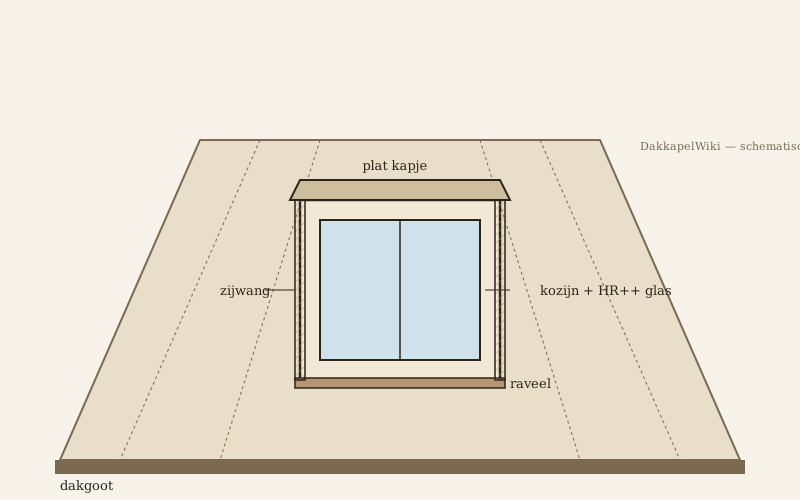
A traditional dormer is a dormer that is built entirely on site. The carpenter starts with an empty structural opening and then builds the frame, side cheeks, roof, cladding, and window frame step by step. Nothing comes ready-made from the factory; everything is created on site using individual components.
Until a few decades ago, this was the standard method in the Netherlands. Meanwhile, prefab has taken over a large part of the market, but traditional dormers are still being built — especially on special buildings, in protected cityscapes, with highly unusual roof shapes, or when the aesthetics committee (Welstandscommissie) requires a specific appearance.
How is it built on site?
The sequence is generally always the same, but every part is made and tailored on site.
Step 1 — Making the roof opening
The roof tiles, counter battens, and roof battens are removed. Then the rafters or purlins are cut at the location of the dormer. At the same time, the trimmer structure is built to support the cut components.
Step 2 — Building the frame
On the trimmer, the frame for the front facade and side cheeks is built. Wooden studs are often used for this, sometimes in combination with steel or plywood.
Step 3 — Insulating and sealing
Between the studs goes insulation (PIR, glass wool, or rock wool). A vapor barrier foil is applied on the inside, and a vapor-permeable foil on the outside. After that, the exterior cladding is attached, and the window frame is placed.
Step 4 — Finishing the roof
The roof receives its slope, insulation, and moisture regulation, and is finished with EPDM, bitumen, or zinc. Lead flashing makes the connection to the existing roof tiles.
Step 5 — Interior finishing
Finally, the inside is finished with plasterboard, plasterwork, windowsill, and trim. In a shell execution, this is left to the resident.
The difference with prefab
The great opposite of traditional building is prefab: a dormer that is built in the factory and hoisted onto the roof in one piece. The most important difference is where the work happens — inside a hall or outside on the roof. Furthermore, they differ in construction time (one day versus one to two weeks), freedom of form (traditional is more flexible), and weather dependency (traditional is more sensitive).
In practice, neither method is automatically better. The right choice depends on the building, the desired shape, accessibility, and planning.
Construction time and flexibility
The construction time of a traditional dormer on site is often between five and ten working days, plus a few days for the interior finishing. During that period, there is some disturbance: scaffolding or a rolling scaffold, noise from sawing and screwing, and carrying materials back and forth.
On the other hand, almost everything can be modified. The carpenter can decide on site to use a slightly wider side cheek, an adjusted detail in the gutter line, or a different position for the window frame. For special homes — think of thatched roofs, mansard roofs, dormers that have to go around a chimney — that is a major advantage.
Materials and finishing
For a traditional dormer, the same materials are usually used as with prefab, but in individual parts:
- Frame: wood (often spruce or Douglas fir) or steel beams for larger spans.
- Insulation: PIR boards, glass wool, or rock wool.
- Foils: vapor barrier foil on the inside, vapor-permeable foil on the outside.
- Exterior cladding: plastic, wood, zinc, polyester, Keralit, or Trespa.
- Roof: EPDM, bitumen, or zinc.
- Window frame: wood, plastic, or aluminum, with HR++ or triple glazing.
The advantage of individual parts is maximum freedom of combination. The disadvantage is that the final quality depends on the way these parts connect to each other — and therefore on the craftsmanship of the carpenter.
Risks of building outside
Building a dormer on site brings along a number of specific risks.
- Weather influence: rain during construction can wet the existing roof structure, resulting in later mold formation.
- Working at heights: fall protection, roof fences, and safe scaffolding are not optional.
- Deviations in dimensions: a carpenter working on a steep slope is naturally more prone to making a millimeter error than a factory robot.
- Neighborhood disturbance: several days of noise and construction activity.
- Dependency on weather in planning: a storm can easily shift a project by a few days.
Good professionals work with temporary protective covers or tarpaulins and carefully plan workdays around the weather forecast.
Structural points of attention
Whether a dormer is prefab or traditional, the load-bearing structure must always be solid. In traditional construction, there is extra freedom to adapt the structure to an unusual roof shape, but this also means construction errors can occur more easily.
- The trimmer joist must have sufficient dimensions to support the cut rafters.
- The sleeper (longitudinal wood on the existing structure) distributes the load of the dormer.
- For wide dormers, a steel profile may be required to span large distances.
- Connections between old and new wood must be made using the correct fasteners.
When in doubt, have a structural engineer make the calculation; for large dormers or special roofs, this is almost always recommended.
When traditional makes sense
A traditional dormer is a good choice if:
- the building has a special roof shape (mansard roof, gambrel roof, thatched roof);
- the aesthetics committee requests a specific detailing;
- a crane cannot reach the building due to narrow streets or overhanging trees;
- the property is a monument or located in a protected cityscape;
- the builder desires maximum customization.
A traditional approach is less logical for standard terraced and dual-aspect houses where prefab fits easily, and for projects where the lead time is critical.
Common mistakes
- Too light trimmer structure causing the dormer to sag later on.
- Insufficient protection against rain during the construction phase.
- Sloppy connection of side cheeks to roof tiles, resulting in leaks.
- Forgetting the vapor barrier foil or damaging it during work.
- Insulation that is too thin or thermal bridges around the window frame.
- No ventilation solution in the window frame, resulting in condensation and mustiness in the attic.
Practical checklist
- Is there a construction drawing with details for the trimmer, side cheeks, and roof?
- Is a structural calculation available, especially for larger spans?
- Is there a schedule with weather margins?
- Is there a tarpaulin or temporary protective cover for rainy days?
- Which foils are used and how are they connected?
- What glass is being installed — is fall-safe glass mandatory?
- How are lead flashing and roof tiles detailed around the dormer?
- What has been agreed regarding completion and warranty?
Comparison table
| Situation | Traditional logical? |
|---|---|
| Standard terraced house with a gable roof | Usually no — prefab suffices |
| Mansard roof with a pitch break | Yes |
| Monument or protected cityscape | Yes |
| Narrow street with no room for a crane | Yes |
| Rush job with a short lead time | No — prefab is faster |
| Specific aesthetics committee requirement | Often yes |
Frequently asked questions
Brief answers to frequently asked questions on this topic.
- How long does a traditional dormer take?
- On site, usually five to ten working days for the shell, plus a few days for interior finishing. It can take longer for complex roofs.
- Is a traditional dormer more expensive than prefab?
- Not by definition, but for standard sizes, prefab is often cheaper due to economies of scale. For special work, traditional can be competitive.
- What are the biggest risks with traditional building?
- Rain during the construction phase, poor connections to the existing roof tiles, and thermal bridges around the window frame are the most common pitfalls.
- Do I need a crane?
- Usually not. Materials are delivered in individual parts and processed by hand on the roof, possibly using a ladder lift.
- Is a traditional dormer better insulated than a prefab one?
- Not automatically. The insulation package can be just as good, but prefab has the advantage of factory control.
- What does the aesthetics committee do regarding a traditional dormer?
- The aesthetics committee can set requirements for material choice, color, moldings, and placement. These requirements are often stricter in protected cityscapes.
- Can a traditional dormer also be built without planning permission?
- Yes. The need for planning permission depends on location and dimensions, not on the construction method.
- Which wood is often used?
- Spruce or Douglas fir, sometimes modified woods like Accoya for high-quality executions.
- How is the dormer protected against rain during construction?
- With tarpaulins, temporary protective covers, or an enclosed scaffold above the construction opening.
- How long does a traditional dormer last?
- With good execution and regular maintenance, easily thirty to fifty years, sometimes longer.
Summary
A traditional dormer is built entirely on site, offering maximum customization and flexibility, but with a longer construction time and greater weather dependency. It is a good choice for special buildings, mansard roofs, monuments, and situations where a crane cannot enter. The final quality is strongly tied to the craftsmanship of the builder.
Conclusion
Traditional building is not outdated — it is a serious, viable approach for projects where prefab does not fit. Those who opt for a traditional build choose craftsmanship and customization, and must accept that planning and neighborhood disturbance are somewhat greater. A good traditional dormer lasts for decades and has a refinement in detailing that prefab often fails to achieve.
Rules for planning permission, aesthetic guidelines, and typical construction vary by municipality. View the information for your city or see the full region overview.
- Noord-HollandDormer Amsterdam
- Zuid-HollandDormer Rotterdam
- Zuid-HollandDormer Den Haag
- UtrechtDormer Utrecht
- Noord-BrabantDormer Eindhoven
- GroningenDormer Groningen
- Noord-BrabantDormer Tilburg
- FlevolandDormer Almere
- Noord-BrabantDormer Breda
- GelderlandDormer Nijmegen
- GelderlandDormer Arnhem
- Noord-HollandDormer Haarlem