Prefab dormer: complete explanation
A prefab dormer has become the standard solution in the Netherlands for anyone wanting to expand their attic. The dormer is entirely built in a factory, transported to the address on a truck, and hoisted onto the existing roof in one go using a crane. As a result, the structural shell is often wind and watertight within a day. This guide explains exactly how prefab production works, the difference with traditional construction, who prefab is suitable for, and what points you need to pay extra attention to — from transport and hoisting to the connection with the existing roof and the insulation package.
What is a prefab dormer?
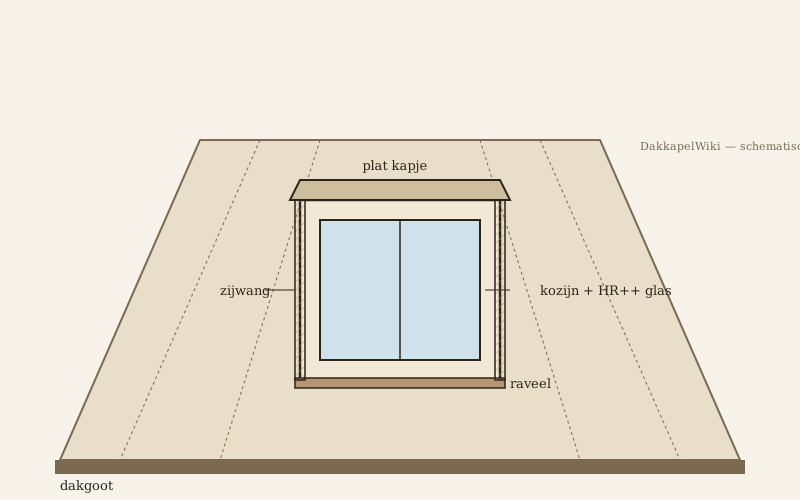
A prefab dormer is a dormer that is made off-site. Instead of a carpenter building a frame on the roof, finishing the side walls, and installing a window frame, all that work takes place in a production hall. Based on on-site measurements, a dormer is fully constructed there: the frame, insulation, window frame with glass, small roof, fascia board, and exterior cladding are all finished before the dormer reaches the address.
The concept is not new, but due to improved production techniques, better insulation materials, and heavier mobile cranes, prefab is now the most frequently chosen option in the Netherlands.
What is usually included?
A prefab dormer is almost always delivered including insulation, window frame, glazing, roofing (usually EPDM or zinc), fascia board, and exterior cladding. Within the order, you can choose versions such as shell (casco - without interior finishing) or complete (with plasterboard, windowsill, and plasterwork).
How does the production work?
The process begins with an on-site measurement. A mechanic measures the roof, checks the roof pitch, looks at the position of the rafters and purlins, and determines whether the desired dimensions fit within the rules for building without planning permission.
Production in the hall
Based on that measurement, a wooden or steel frame is built in the factory. The side walls are finished, fitted with insulation and cladding. The window frame is installed and the glazing is applied. The small roof receives its slope and is finished with EPDM, bitumen, or zinc.
Transport
The completed dormer is placed on a special transport trailer. A large version may require wide load transport, which needs special routes and sometimes an escort vehicle. For narrow streets or restricted height (tunnels, viaducts), a route check is done beforehand.
Hoisting and placement
A loader crane or mobile crane is stationed on-site. Roof tiles are stripped, rafters are sawn open, and the trimmer framework is made. Next, the crane hoists the dormer as a single unit onto the roof, after which it is aligned and secured to the structure. Subsequently, the lead flashing, roof tiles, and any interior finishing are added.
Difference with traditional construction
A traditional dormer is built piece by piece on-site. First the frame, then the insulation, then the cladding, then the window frame, then the roof. This takes longer and is more sensitive to the weather, but it offers maximum freedom in design and detailing.
A prefab dormer comes ready-made from the factory. This is faster and more reliable in terms of dimensions, but the shape is limited to what the factory can produce. Especially with unusual roof shapes, mansard roofs, dormers that suddenly need to make a bend, or asymmetrical placements, some builders still opt for traditional.
Work that remains the same
Whether a dormer is prefab or traditional, the following work is always done on-site: removing the roof tiles, making the trimmer framework, connecting the roof tiles, lead flashing, and gutter, and potentially completely finishing the inside.
Advantages of prefab
- Speed on-site: usually wind and watertight within one day.
- Consistent dimensions: indoor production generally yields a neater finish than carpentry work on a steep roof.
- Less weather dependency: the dormer itself is built in dry conditions; only the hoisting moment is weather-sensitive.
- Predictable planning: the lead time from measurement to placement is largely fixed.
- Often a more favorable price: economies of scale in production translate into more competitively priced versions.
- Limited nuisance for the neighborhood: a single day of installation is shorter for the surroundings than a week of carpentry on the roof.
Disadvantages and limitations
- Limited design freedom: not every factory makes every shape, angle, or detail.
- Accessibility: the crane may have difficulty positioning in a narrow street or near overhanging trees.
- Transport limits: very large dormers can complicate road transport.
- Standard versions may visually differ from a traditional house with fine detailing in moldings and cladding.
- Dependence on a single manufacturer: in case of warranty claims, there is usually just one party to deal with.
For most terraced houses and through-lounge houses, the advantages far outweigh these disadvantages. For monuments and extraordinary buildings, the opposite may apply.
Materials and insulation
The exterior of a prefab dormer is available in plastic panels, wood, zinc, polyester, Keralit, or Trespa. The choice determines maintenance, lifespan, and appearance. On the inside, there is an insulation package usually containing PIR boards or mineral wool.
A good prefab dormer easily achieves an Rc-waarde (thermal resistance value) of 5 m²K/W or higher, and is equipped with HR++ or triple glass. For waterproofing, EPDM or zinc is applied to the roof, and lead flashing or an equivalent material is used for the connection to the roof tiles.
Vapor regulation
Just as with traditional construction, the rule applies: a vapor barrier foil on the inside, and a vapor-permeable foil on the outside. With prefab, this is already built-in at the factory, making it less prone to errors than manual work on the roof.
When prefab is suitable
Prefab is a logical choice if:
- the house has a regular roof shape (gable roof or mansard roof with a standard pitch);
- there is sufficient space available for a crane;
- the desired dormer fits within standard dimensions;
- the planning is important — for example, to tie in with a move or a birth;
- the owner wants to keep nuisance to a minimum.
Prefab is less suitable for highly irregular roof shapes, monuments with non-standard detailing, locations without space for a crane, or plans where the aesthetics committee (welstandscommissie) explicitly requests a traditional design.
Common misconceptions
- "Prefab is always cheaper." Not necessarily. For a large, complex dormer with non-standard dimensions, traditional construction can be competitive.
- "Prefab quality is always higher." Factory work is often more consistent, but it still stands or falls with the connection to the existing roof.
- "A prefab dormer is habitable within one day." The structural shell is closed within one day, but interior finishing, painting, and plastering require additional days.
- "A prefab dormer does not need to be assessed by a structural engineer." For the trimmer framework and attachment to the existing roof structure, structural assessment is often still desirable.
Practical checklist
- Has an on-site measurement been done?
- Does the desired dormer fit within the dimensions for building without planning permission?
- Is there room for a crane, and is a route check needed for transport?
- Is EPDM, zinc, or bitumen applied to the roof?
- What glass is supplied (HR++, triple), and is fall-safe glass required?
- Is there a ventilation solution in the window frame (vent, tilt-and-turn window)?
- Has it been agreed upon who is responsible for putting back the roof tiles and the lead flashing?
- Is the handover documented with photos and a checklist?
- How long is the warranty period, and what exactly does it cover?
Comparison table
| Aspect | Prefab | Traditional |
|---|---|---|
| Construction time on-site | 1 day | 1–2 weeks |
| Dimensions | Factory precision | Carpenter's craftsmanship |
| Freedom of design | Limited to factory catalog | Maximum |
| Weather dependency | Limited | High |
| Crane required | Yes | Usually not |
| Warranty | Often factory warranty | Depends on the contractor |
Frequently asked questions
Brief answers to frequently asked questions on this topic.
- How long does it take to install a prefab dormer?
- The structural shell is usually placed and made wind and watertight in one working day. Interior finishing takes a few extra days.
- Do I always need a crane?
- Yes, a prefab dormer is too heavy to manually lift onto the roof. A loader crane or mobile crane is always required.
- What happens if the crane cannot properly access the site?
- Sometimes a larger crane with a longer reach can be used. If that is not possible, a traditional dormer or a heavily modified prefab setup is an alternative.
- Is a prefab dormer as well-insulated as a traditional one?
- In practice, often better, because the insulation package is applied under controlled conditions in the factory.
- Does prefab fit on every type of roof?
- For most gable roofs and mansard roofs, yes. For uncommon roof shapes or very shallow pitches, custom work or a traditional build may be necessary.
- Is a prefab dormer always exempt from planning permission?
- No. Whether a dormer can be built without planning permission depends on the location and dimensions — not on the construction method.
- What about noise with a prefab dormer?
- Thanks to the mass of the glass and fascia board and the use of solid panels, a prefab dormer is acoustically comparable to a traditional build.
- What warranty is customary?
- The structure and waterproofing often carry a multi-year warranty; a shorter term usually applies to paintwork and mechanical parts.
- Can the exterior cladding be changed later?
- In principle yes, but it is a fairly invasive job. The choice of cladding when ordering is therefore an important decision.
- What if the crane cannot come on the installation day due to bad weather?
- In the event of high winds or a thunderstorm, hoisting is almost always postponed. Thoroughly discuss the agreements regarding this in advance with the supplier.
Summary
A prefab dormer is an entirely factory-built extension that is hoisted onto the roof in a single piece. The method is gaining popularity due to the speed, predictability, and quality of the factory work. Important considerations include accessibility for a crane, dimensions, and the connection to the existing roof — work that always takes place on-site, even with prefab.
Conclusion
Anyone considering a dormer is well-advised to seriously evaluate prefab. For standard houses, it is often the logical choice: fast, with predictable quality, and relatively little nuisance. For uncommon buildings or complex roof shapes, a traditional build remains a valuable option. The choice depends not only on price, but mainly on the structural prerequisites and the desired shape.
- Prefab dormer — concepts page
- Traditional dormer
- Structural shell dormer
- Plastic dormer
- Wooden dormer
- Polyester dormer
- Zinc dormer
- Dormer with a flat roof
- Dormer at the front
- Dormer at the rear
- What is a trimmer framework?
- Structural points of attention
- Keralit panels
- Zinc as roof cladding
- Components of a dormer
- Structure of a dormer
Rules for planning permission, aesthetic guidelines, and typical construction vary by municipality. View the information for your city or see the full region overview.
- Noord-HollandDormer Amsterdam
- Zuid-HollandDormer Rotterdam
- Zuid-HollandDormer Den Haag
- UtrechtDormer Utrecht
- Noord-BrabantDormer Eindhoven
- GroningenDormer Groningen
- Noord-BrabantDormer Tilburg
- FlevolandDormer Almere
- Noord-BrabantDormer Breda
- GelderlandDormer Nijmegen
- GelderlandDormer Arnhem
- Noord-HollandDormer Haarlem