
Ventilation and condensation in dormers
A well-insulated dormer is by definition airtight. That is a gain for comfort, but without targeted ventilation, the room quickly becomes stuffy, damp, and musty. Especially in the loft — where people often sleep, shower, or work — ventilation deserves just as much attention as insulation. This guide discusses the difference between natural and mechanical ventilation, how condensation occurs, how to recognize and solve moisture problems, and which ventilation choice suits which use (bedroom, bathroom, workspace).
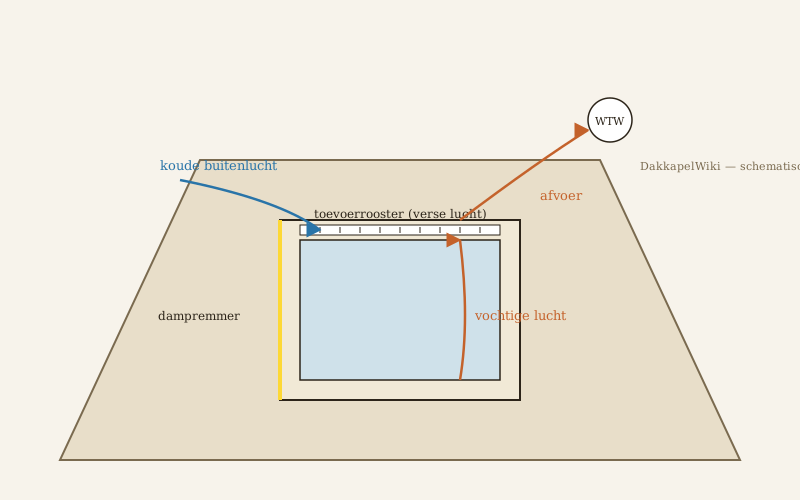
Why ventilation is so important
People continuously produce moisture: breathing, perspiring, cooking, showering. In a well-insulated house, that moist air lingers if no fresh air enters. The result is an increased relative humidity, and on cold surfaces, condensation leading to mold over time.
A dormer is situated high up in the home. Warm, moist air from the kitchen or bathroom rises and mostly ends up on the loft floor. This makes the dormer — especially in winter — one of the first places where building physics problems become visible.
Ventilation ensures that moist indoor air is extracted and replaced by drier outdoor air. Not just once, but continuously.
Natural ventilation
Natural ventilation uses wind and temperature pressure differences between indoors and outdoors. No pumps or fans are involved.
- Ventilation grilles in the frame above or in the side window of the frame let air in.
- Cracks and gaps in older homes provide passive — often unwanted — ventilation.
- An open window is a strong but uncontrollable form of natural ventilation.
Natural ventilation is sufficient for most bedrooms and workspaces, provided the grilles can remain open. The main disadvantage is that they depend on the weather: when there is no wind, natural ventilation barely works.
Mechanical ventilation
Mechanical ventilation uses a fan to move air. There are three main variants:
Mechanical extraction
A central fan extracts air in wet rooms (bathroom, kitchen, toilet). Fresh air comes in through grilles in other rooms. Practical and relatively simple.
Balanced ventilation
A unit simultaneously blows in fresh air and extracts stale air, often with heat recovery (WTW - warmteterugwinning). Energy-efficient, but requires a more extensive duct network.
Local ventilation
A facade fan or a fan in a window ventilates a single room. Useful for a separate loft bathroom where the main ventilation system doesn't reach.
Tilt-and-turn window with ventilation position
A tilt-and-turn window can both turn (fully open) and tilt (ajar). In the tilt position, there is continuous ventilation without creating a large hole in the facade. For a dormer used as a bedroom, this is often the most pleasant solution: at night, the window can be left ajar without worry.
For extra certainty, a fine dust filter or insect screen can be installed. In busy inner cities, that can make the difference between a good night's sleep and annoyance over traffic noise.
Condensation formation
Condensation occurs when warm, moist air touches a cold surface and loses its moisture there. With a dormer, there are three places where this often happens:
Glass
On cold winter mornings, there is moisture on the inside of the glass. A result of too little ventilation and/or a moderate U-value of the glass or frame. Often solvable by airing out the room well every day and opening a window grille.
Window frame edges
On the edge of the window frame — especially the bottom sill — condensation can form if there is a thermal bridge (koudebrug). A continuous insulation layer around the window frame, plus sufficient ventilation, helps the most here.
Invisible condensation in the construction
The most dangerous is condensation in the insulation: moisture is hidden between the walls and only becomes visible when mold bleeds through or when wood starts to rot. You prevent this with a correctly applied vapor control layer (dampremmende folie).
Recognizing moisture problems
Common signs of moisture and ventilation problems:
- Fogged up windows in the winter.
- Dark spots or mold on window frame edges and corners.
- A musty smell in the loft room.
- Moisture patches on plasterboard or wallpaper.
- Warping wood in windowsills or finishing.
The initial reaction is often: more cleaning. The real solution is almost always: more ventilation and, where necessary, correcting vapor regulation.
Mold: causes and approach
Mold formation is not an aesthetic but a health problem. Spores cause respiratory complaints and deterioration of structural timber. The cause is almost always structural — a one-off cleaning round is not enough.
- Increase ventilation (open grille, active mechanical extraction).
- Inspect the connection between the dormer and existing roof, especially lead flashing.
- Check the vapor control layer where possible.
- Replace affected material, instead of painting over it.
- In case of persistent problems, ask a moisture specialist or structural engineer for a diagnosis.
Loft use: bedroom, bathroom, or workspace
Bedroom in the loft
Sufficient continuous ventilation is most important here. A window grille or a tilt-and-turn window in ventilation position usually works well.
Bathroom in the loft
A bathroom produces a lot of moisture in a short time. Here, mechanical extraction is almost always necessary. Combine with a humidity-controlled ventilation box that automatically turns on at high humidity.
Workspace / office
A workspace with one or two people is relatively easy to ventilate in terms of moisture via natural ventilation. More important here is the CO₂ load: at high concentrations, concentration drops. Install a CO₂ meter if necessary.
Overheating in the summer
A well-insulated dormer retains heat — thus also the heat that entered during the summer. Without measures, it becomes stuffy at night.
- Exterior sun shading keeps solar heat out — the most effective measure.
- Night ventilation: opening windows in the evening and at night so that colder outdoor air comes in.
- Purge ventilation: briefly air out the loft well in the morning before the day warms up.
- Mechanical ventilation with a heat recovery bypass can provide extra cooling in the summer.
Common mistakes
- Grilles taped shut to prevent drafts.
- Mechanical extraction turned off because of noise.
- No ventilation in a loft bathroom, resulting in rapid mold formation.
- Forgotten vapor control layer or damage during interior finishing.
- Long exhaust ducts with too many bends, causing the extraction to underperform.
- No exterior sun shading while the dormer faces south.
Comparison table
| Function | Recommended ventilation | Point of attention |
|---|---|---|
| Bedroom | Natural ventilation + tilt-and-turn window | Leave grille open |
| Bathroom | Mechanical extraction, preferably humidity-controlled | Short, smooth ducts |
| Workspace | Natural ventilation, optionally CO₂-controlled | Brief purge ventilation |
| Laundry room | Mechanical extraction | Long run time after use |
Frequently asked questions
Brief answers to frequently asked questions on this topic.
- Why does condensation form on my dormer window?
- Because warm, moist indoor air touches a cold surface. More ventilation and possibly better glass solve this.
- Is a window grille enough ventilation?
- For a bedroom or workspace, often yes. For a bathroom or kitchen, mechanical extraction is better.
- What is balanced ventilation?
- A system that blows in and extracts at the same time, often with heat recovery.
- Must the vapor control layer always be airtight?
- Yes. Even a small interruption can cause hidden condensation.
- Can a ventilation grille be closed in the winter?
- Better not. Ventilation is actually essential in winter to remove moisture.
- How often should I air out?
- In addition to continuous ventilation, opening windows for ten to fifteen minutes daily is a good habit.
- What is a humidity-controlled ventilation box?
- A mechanical extraction system that increases its capacity as soon as humidity rises.
- Does a dehumidifier help against condensation?
- Symptomatically yes, but it does not address the cause (too little ventilation).
- What do I do about mold in the corner of my dormer?
- First find the cause — almost always too little ventilation or a thermal bridge. Then clean with a fungicide and have the building physics cause repaired.
- Does ventilation help against overheating in the summer?
- Yes, provided it is combined with exterior sun shading. Only ventilating in the heat is counterproductive.
Summary
Good ventilation is just as important for a dormer as insulation. Natural ventilation is sufficient for most bedrooms and workspaces; bathrooms and laundry rooms require mechanical extraction. Condensation is caused by a mismatch between moisture and surface temperature and is prevented by correct foils, continuous insulation, and adequate air renewal. Exterior sun shading and night ventilation are crucial against overheating in the summer.
Conclusion
Whoever installs insulation without ventilation solves one problem and creates the next. A dormer that is technically sound always combines three things: a continuous insulation layer, correctly applied vapor regulation, and a ventilation solution that suits the function of the room. This is not an extra: it is a prerequisite for years of healthy and comfortable loft use.
Rules for planning permission, aesthetic guidelines, and typical construction vary by municipality. View the information for your city or see the full region overview.
- Noord-HollandDormer Amsterdam
- Zuid-HollandDormer Rotterdam
- Zuid-HollandDormer Den Haag
- UtrechtDormer Utrecht
- Noord-BrabantDormer Eindhoven
- GroningenDormer Groningen
- Noord-BrabantDormer Tilburg
- FlevolandDormer Almere
- Noord-BrabantDormer Breda
- GelderlandDormer Nijmegen
- GelderlandDormer Arnhem
- Noord-HollandDormer Haarlem