
Dormer insulation: complete guide
A dormer is situated high up in the home, often on an attic floor that gets hot in the summer and cools down quickly in the winter. Good insulation is therefore not a luxury but a prerequisite for a healthy, comfortable space. At the same time, insulation is not just about the thickness of an insulation board — **thermal bridges**, **vapor control**, **draught-proofing**, and the **U-value** of the glass also play a role. This guide explains how the insulation package of a dormer is put together, which materials are used, and what is at stake from a building physics perspective.
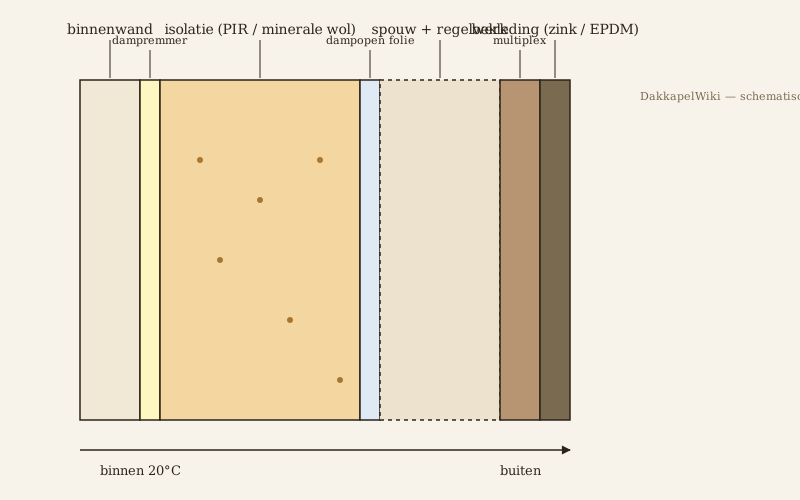
Why insulation is so important
A dormer is a protrusion in the outer shell of the home. It has three outer sides that lose heat (front facade, two side cheeks, small roof) and additionally a glass surface. That makes it a vulnerable component energetically. A well-insulated dormer is pleasantly warm in the winter without high heating costs, and in the summer the insulation dampens the solar heat.
Poorly insulated dormers are recognizable by cold walls around the window frame, condensation on the glass in the winter, and overheating in the summer. Often, after a few years, mould formation also occurs at connection points. That is not an inevitable consequence of a dormer: with proper execution, it simply does not happen.
Rc-value and U-value
Rc-value is the thermal resistance of a closed structure, expressed in m²K/W. The higher, the better the insulation. For new builds, the current building regulations (Bouwbesluit/Omgevingswet) mandate a minimum of 6,3 m²K/W for the roof surface. For dormers, 4,5–6,0 m²K/W is often used, depending on what fits structurally.
U-value is the thermal transmittance coefficient of a building component, expressed in W/m²K. The lower, the better. Glass and window frames are evaluated by U-value:
- HR++ glass: U ≈ 1,1 W/m²K
- Triple glass: U ≈ 0,5–0,7 W/m²K
- Good uPVC window frame: U ≈ 1,3 W/m²K
- Combined window frame + glass (Uw): usually between 1,1 and 1,5 W/m²K
Thermal bridges
A thermal bridge is a spot in the construction where heat escapes to the outside faster than in the rest of the wall. Typical thermal bridges in a dormer:
- Corner connections between the side cheek and front facade if the insulation is interrupted there.
- Connection of the window frame to the wall when the window frame is placed outside the insulation layer.
- Fasteners made of metal that pierce through the insulation layer.
- Trimmer joist structure if the existing roof construction is colder than the dormer itself.
On a thermal bridge, condensation will occur in a humid indoor climate. This will later lead to mould growth. A sensible design keeps the insulation layer continuous around the entire dormer.
PIR, glass wool, and rock wool
PIR
PIR is a rigid foam with a high insulation value per centimeter. A 100 mm panel often achieves an Rc-value of 4,3 m²K/W. PIR is ideal when space is limited, but works less well on uneven surfaces.
Glass wool
Glass wool is a mineral wool made from molten glass, available as boards or rolls. Easy to apply in niches, acoustically strong, and relatively cheap. Insulates slightly less per centimeter than PIR.
Rock wool
Rock wool is similar to glass wool, but is firmer and has a higher fire rating. It is often used in places where fire resistance plays a role.
In practice, the insulation package for a dormer is often a combination: PIR where it is tight, mineral wool where there is enough space and acoustics matter.
Vapor control: inside and outside
Heat goes hand in hand with moisture. Without membranes, warm, humid indoor air penetrates the insulation, where it condenses and damages the structure.
Vapor control layer on the inside
On the inside of the insulation package belongs a vapor control layer (dampremmende folie). This stops moisture before it reaches the insulation. Seams must be carefully taped with butyl tape, and penetrations (sockets, cables) sealed.
Breathable membrane on the outside
On the outside, between the insulation and the cladding, is a breathable membrane (dampopen folie). This allows any penetrated moisture to escape and keeps rain out.
Without these two membranes, thick insulation is counterproductive — it actually becomes a moisture problem.
Window frames and glazing
A dormer loses relatively much energy through the window. Anyone who only insulates the walls and installs cheap glass misses a large part of the gain.
Glazing choice
- HR++ is a good baseline for most situations.
- Triple glazing makes a particular difference with large glass surfaces or bedrooms where you might be woken up by a cold downdraught in the winter.
Window frame quality
A well-insulated window frame with multi-chamber profiles and thermal breaks makes a big difference. A dormer with top-tier glazing in a mediocre frame often performs worse than the other way around.
Side cheeks and roof
The side cheeks and the roof are often forgotten because they are out of sight. Yet they are relatively large surfaces directly in contact with the outside air.
- Side cheeks deserve at least the same insulation thickness as the front facade.
- The roof is often the narrowest package; PIR pays off here because the thickness is limited.
- With replaceable shutters or inspection hatches in side cheeks, the insulation must continue.
Sound and acoustics
A well-insulated dormer not only keeps heat in, but also dampens ambient noise. This is especially relevant for dormers on a busy street, close to a tram line, or under a flight path.
- Glazing with asymmetrical pane thicknesses dampens sound better than symmetrical HR++.
- Good sealant application around the window frame prevents sound leaks.
- Mineral wool dampens sound better than PIR.
- Mass helps: a dormer with solid cladding on a good frame sounds much more peaceful than a thin-walled variant.
Summer comfort and sun protection
A dormer with a lot of glass facing south or west can heat up considerably in the summer. Insulation also keeps heat indoors, so without countermeasures, it even becomes stuffy in the evening.
- Exterior sun protection (screens, drop-arm awnings) keeps solar heat out and is more effective than interior blinds.
- Sun-control glass lowers the g-value but also dampens the winter sun.
- Ventilation with a tilt-and-turn window or mechanical extraction is essential on warm days.
Common mistakes
- Interrupted insulation layer at corners and connections.
- Forgotten or damaged vapor control layer.
- Window frame placed outside the insulation layer, resulting in a major thermal bridge.
- Triple glazing in a lightweight frame that cannot handle the weight.
- No exterior sun protection on a south- or west-facing facade.
- Too many seams in the insulation boards without filling or taping.
Comparison table
| Material | Rc per 10 cm (approx.) | Fire rating | Acoustics | Strengths |
|---|---|---|---|---|
| PIR | ≈ 4,3 m²K/W | C/D | Limited | High insulation per cm, rigid |
| Glass wool | ≈ 2,8 m²K/W | A1 | Good | Cheap, flexible, acoustic |
| Rock wool | ≈ 2,8 m²K/W | A1 | Good | Fire-resistant, sturdy |
Frequently asked questions
Brief answers to frequently asked questions on this topic.
- What Rc-value is common for a dormer?
- A minimum of 4,5 m²K/W, preferably 5 or higher. Higher requirements apply to new build roofs.
- What is the difference between Rc and U?
- Rc applies to solid structures, and higher = better. U applies to frames and glass, and lower = better.
- Do I still need ventilation with a well-insulated dormer?
- Yes, even more so. An airtight package requires targeted ventilation via a vent or mechanical extraction.
- What is a thermal bridge and how do I prevent it?
- A spot where heat escapes faster than elsewhere, often due to interrupted insulation. Prevent this by laying the insulation layer continuously around the dormer.
- Is PIR always better than glass wool?
- Per centimeter, PIR provides better insulation, but mineral wool scores better on acoustics and fire resistance.
- Is triple glazing worth it in a dormer?
- Often yes, especially with large glass surfaces and in bedrooms. Do make sure the window frame can support the weight.
- Does the vapor control layer need to be completely sealed?
- Yes. Seams and penetrations must be taped; a hole of just a few millimeters can already cause condensation.
- What if condensation appears on the glass after a few years?
- Often a combination of insufficient ventilation and a thermal bridge at the window frame. First increase ventilation, then have the connection checked.
- Does insulation also help against overheating?
- Indirectly yes, but exterior sun protection and ventilation are more decisive for summer comfort.
- Can I have my existing dormer better insulated?
- Yes, but it is a major job because the cladding or interior finish must be removed to apply the insulation layer.
Summary
Dormer insulation is about more than just thick boards. Rc-value, U-value of glass and frame, thermal bridges, and vapor control are all indispensable. PIR delivers high performance per centimeter; mineral wool scores well on acoustics and fire resistance. The vapor control layer on the inside and breathable membrane on the outside are just as important as the insulation itself. Ventilation and exterior sun protection complete the package.
Conclusion
A dormer stands or falls by the meticulousness of the insulation work. The difference between a dormer that feels pleasant for years and one where water droplets run down the glass in the winter does not lie in the price of the insulation board — but in the continuity of the insulation layer, the correct implementation of membranes, and the quality of the glass and window frame. Anyone who has these three things in order will have a dormer that remains comfortable for decades.
Rules for planning permission, aesthetic guidelines, and typical construction vary by municipality. View the information for your city or see the full region overview.
- Noord-HollandDormer Amsterdam
- Zuid-HollandDormer Rotterdam
- Zuid-HollandDormer Den Haag
- UtrechtDormer Utrecht
- Noord-BrabantDormer Eindhoven
- GroningenDormer Groningen
- Noord-BrabantDormer Tilburg
- FlevolandDormer Almere
- Noord-BrabantDormer Breda
- GelderlandDormer Nijmegen
- GelderlandDormer Arnhem
- Noord-HollandDormer Haarlem