Dormer construction: complete explanation
The structural heart of a dormer is invisible but decisive. A dormer alters the existing roof structure by locally interrupting rafters or purlins. This must be structurally accommodated, otherwise the roof will eventually sag or, in the worst case, fail under wind or snow loads. This guide explains how a dormer construction is made, which roof shapes exist, what forces act upon them, and why a serious dormer should always be assessed by a structural engineer.
The existing roof structure
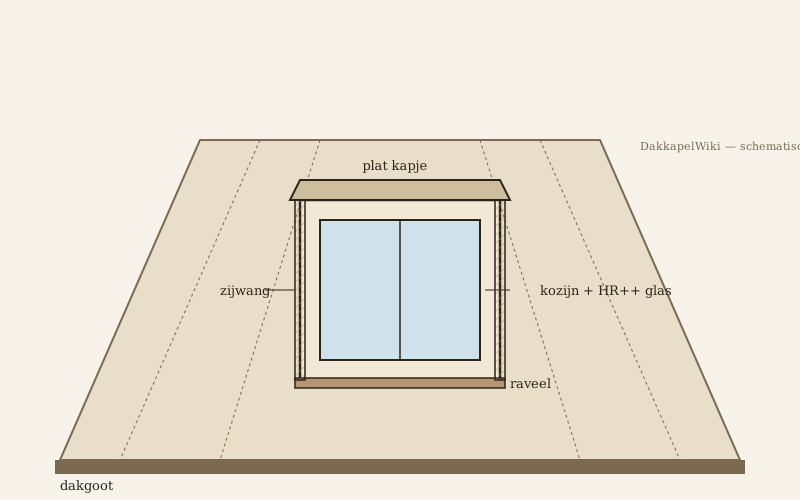
Before a dormer can be placed, it is important to know what you are building on. Two main shapes occur in Dutch homes.
Purlin roof
In a purlin roof, there are horizontal purlins running across the width of the home, supported by load-bearing walls or a ridge purlin. The roofing rests on counter battens and tile battens on top of these purlins. A purlin roof is usually easier to place a dormer in, because there is space for the opening between the purlins.
Rafter roof
In a rafter roof, sloping rafters run from the wall plate to the ridge, often in a tight grid (40 to 80 cm). A dormer in a rafter roof means that multiple rafters are interrupted, and the load must be redistributed via a trimmer construction. Structurally, this requires more attention.
The trimmer construction
A trimmer construction is a wooden or steel structure installed around the roof opening. The trimmer supports the interrupted rafters or purlins and transfers the load to the adjacent structural components.
Connecting rafters
The cut rafters are attached to the trimmer joist, which runs perpendicular to the rafter direction. At both ends, the trimmer joist meets a load-bearing rafter that is heavier or doubled up.
Mutual connections
The connections between the trimmer joist and load-bearing rafters are made with joist hangers or steel connectors. Nails alone are not enough: the trimmer construction must bear the load for decades.
Sleeper beams
A sleeper beam is a longitudinal timber placed on or along the existing roof structure to carry the dormer. The sleeper beam distributes the load of the dormer over multiple rafters or purlins, rather than transferring that load as a point load onto a single element.
The sleeper beam plays an important role, especially with prefab dormers: the factory construction is placed on the sleeper beam and the sleeper beam transfers the entire load to the existing roof.
What forces act on a dormer?
A dormer must be able to handle more than just its own weight.
Dead weight
The sum of structure + insulation + cladding + roof + window frame + glass. For large dormers, this can amount to several thousand kilos.
Wind load
A dormer protrudes above the existing roof surface and catches wind forces that would otherwise not be there. Especially on corner locations and in open terrain, this yields significant horizontal forces.
Snow load
Snow can accumulate on the flat roof of a dormer. Moreover, the pitched roof surface above can discharge snow downwards onto the dormer roof.
Person load
During periodic inspection or maintenance, someone walks on the roof. The structure must be calculated to handle this without sagging.
Combinations
A structural engineer does not only calculate each load separately, but also calculates combinations such as "dead weight + snow + wind" to assess the most unfavorable situation.
Making the roof opening
Before the dormer can be placed, an opening is made at the agreed location. This is done as follows:
1. Roof tiles are removed and stacked on the scaffolding or in the garden. 2. Counter battens and tile battens are removed. 3. Vapour-permeable foil is cut open. 4. Rafters or purlins are sawed off at the marked location. 5. Trimmer construction is built up, often with double rafters on the side of the opening. 6. Sleeper beam is placed on the trimmer.
Only then may the dormer — prefabricated as a whole, or traditionally part by part — be placed.
Connection to the existing roof
The connection between the dormer and the existing roof is structurally and building-physically critical.
Structural
The dormer is connected to the trimmer construction via steel connectors. In prefab, this is done with anchors and screw connections that grip directly onto the trimmer. In traditional work, the side cheeks are carpentered onto the trimmer.
Building physics
In addition to the structural connection, insulation, vapour regulation, and waterproofing must run continuously. A beautiful structure without continuous insulation means a thermal bridge; continuous insulation without a good connection yields structural risks. Both must be right.
Structural calculation and building plan
For a serious dormer — especially if it is wider than two meters, is placed on a rafter roof, or in a complex building — a structural calculation is advisable. A structural engineer assesses the following:
- Sufficient dimensions of the trimmer joist and sleeper beam?
- Strong enough load-bearing rafters at the sides of the opening?
- Sufficient safety margin for wind and snow loads?
- Use of the correct fasteners?
- For wide dormers: is a steel profile needed?
The calculation is recorded in an architectural drawing which is also required for a planning permission application.
Building plan: what is on it?
A good building plan for a dormer shows at a minimum:
- Floor plan of the existing loft with the dormer's position.
- Cross-section with connection to the roof eaves, ridge, and insulation package.
- Elevations front and side with dimensions.
- Detail of the trimmer construction and connections.
- Choice of materials for frame, insulation, cladding, roof, and glass.
- Reference to structural calculation.
For prefab, the manufacturer supplies these drawings as a standard. For traditional work, this is a separate step.
Safety on the roof
Working on a pitched roof requires strict safety measures. Complete scaffolding, roof edge protection, fall protection, and helmets are standard for professional builders.
For the resident, this is especially important to know as the reason why a dormer project cannot "just be done on the side": preparing on the roof takes time and money, and that is not a place to cut corners.
Common mistakes
- Trimmer joist too light, causing sagging.
- Insufficient load-bearing rafters at the sides of the opening.
- Nail joints without steel reinforcement.
- Sleeper beam too narrow to transfer the load.
- No account taken of wind loads on corner homes.
- No structural calculation for wide dormers.
- Wrong ratio between dormer width and available roof width.
Comparison table
| Roof type | Dormer easier? | Point of attention |
|---|---|---|
| Purlin roof | Yes | Planning the opening between purlins |
| Rafter roof | No | Interrupting more rafters, heavier trimmer construction |
| Mansard roof | Not necessarily | Kink in the roof surface requires custom work |
| Flat roof with extension | Different | See roof extension guide |
Frequently asked questions
Brief answers to frequently asked questions on this topic.
- What is a trimmer construction?
- The wooden or steel structure around a roof opening that carries the cut rafters or purlins.
- Do I always need a structural engineer?
- Not for small dormers on a simple roof, but for wide dormers or a rafter roof, a calculation is highly recommended.
- What is a sleeper beam?
- A longitudinal timber placed on the existing roof structure to support the dormer and spread the load.
- Is a purlin roof always easier?
- Generally yes, but the exact position of the purlins and the desired size of the dormer determine the ultimate ease.
- How heavy is a prefab dormer?
- Depending on the dimensions, often one to three tons, sometimes more. The structure must be calculated for this.
- What if the trimmer joist is too light?
- Then sagging occurs over time, with cracks in the plasterwork and possible leaks at connections.
- How much wind load counts?
- That depends on the location (coast, polder, urban) and the height. A structural engineer calculates this according to NEN norms (Dutch standards).
- Can I make the roof opening myself?
- Technically yes, if you have safety equipment for the roof and structural knowledge. For most residents it is unwise.
- Is a steel profile needed?
- For large widths or special spans, often yes. A structural engineer determines this.
- How do you connect new and old structures?
- With steel fasteners (joist hangers, anchors) that are correctly positioned. Nails alone are never enough.
Summary
The construction of a dormer revolves around correctly accommodating the existing roof shape. Rafters or purlins are breached, trimmer timber supports the load, and a sleeper beam distributes the weight. Wind and snow loads make the whole structure heavier than just its dead weight. For large or special dormers, a structural calculation is not optional but advisable.
Conclusion
Those who think of the appearance of a dormer often forget that its success is hidden: in the beam you never see, in the sleeper beam the weight spreads across, in the connection that must withstand wind and snow. A well-constructed dormer lasts for decades without you ever thinking about it. A poorly constructed one starts to creak within ten years. The difference lies in the construction, and that is exactly where no compromises should be made.
Rules for planning permission, aesthetic guidelines, and typical construction vary by municipality. View the information for your city or see the full region overview.
- Noord-HollandDormer Amsterdam
- Zuid-HollandDormer Rotterdam
- Zuid-HollandDormer Den Haag
- UtrechtDormer Utrecht
- Noord-BrabantDormer Eindhoven
- GroningenDormer Groningen
- Noord-BrabantDormer Tilburg
- FlevolandDormer Almere
- Noord-BrabantDormer Breda
- GelderlandDormer Nijmegen
- GelderlandDormer Arnhem
- Noord-HollandDormer Haarlem