Complete guide to dormers
A dormer is one of the most common interventions on a pitched roof in the Netherlands. Yet, structurally, it is a serious undertaking: an opening is made in the existing roof structure, a new vertical wall is erected, its own small roof is connected, and the entire extension must then be just as watertight, airtight, and well-insulated as the house itself. This guide explains step by step what a dormer is, how it is put together, which variants exist, which materials are used, what the situation is regarding planning permission, and where things often go wrong in practice. The guide is intended for those who truly want to understand what happens on the roof — not for those quickly looking for a quote.
What exactly is a dormer?
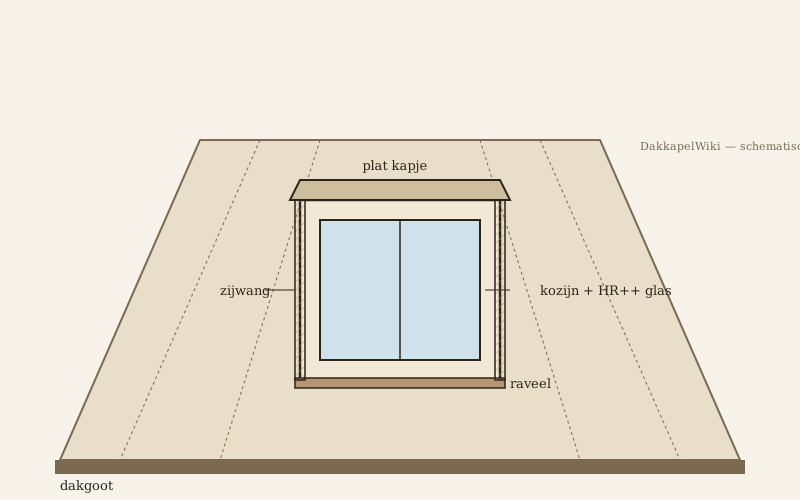
A dormer is an upright extension made in a pitched roof plane to increase the usable space in the attic. Instead of following the pitched roof itself, a section of the roof plane gets a vertical front facade with a window in it, and its own — usually almost flat — small roof that connects to the existing roof structure. This intervention creates local headroom over a wider part of the floor, allows more daylight in, and makes the attic usable as a bedroom, bathroom or home office.
Although a dormer appears to be a simple extension, it requires the same attention as an extension on the ground floor: the structure must be safe, the building physics must be correct (insulation, ventilation, vapor regulation), and the detailing around roof tiles, lead flashing and gutters must be watertight for many years.
Not the same as a skylight or roof extension
A skylight lies flat in the roof plane itself and has no vertical wall or own roof. A roof extension replaces or raises a larger part of the roof and is a much heavier intervention than a dormer. An extended ridge or ridge raising alters the entire roof shape — a dormer leaves the original roofline intact and only protrudes through it locally.
The components of a dormer
A dormer consists of a number of fixed components that together form a single building-physics entity. Each component plays a role in stability, insulation or waterproofing.
Trimming structure
The trimming structure (raveelconstructie) is the wooden or steel frame in the existing roof structure that makes the opening for the dormer possible. When rafters or purlins are cut through, the trimmer frame absorbs the load and transfers it to the adjacent rafters. For a serious dormer, a structural engineer calculates this.
Side cheeks
The side cheeks are the vertical side surfaces that form the transition between the dormer roof and the existing pitched roof plane. They are usually built up from a wooden frame, insulated, and clad on the outside with zinc, plastic, wood, keralit or trespa. Side cheeks are one of the most leak-prone components — especially the connection to the roof tiles requires craftsmanship.
Front facade and window frame
The front facade is the vertical plane containing the window frame. This is where the glass is located, providing daylight and visibility. The choice of one wide frame, two or three frames, and the combination with fixed glass or tilt-and-turn windows determines both the appearance and the ventilation options.
Roof and fascia board
The roof is usually almost flat, with a minimal slope for water drainage. It is finished with EPDM, zinc or bitumen. A fascia board closes off the top of the front facade and gives the dormer its characteristic face.
Interior finishing
The inside usually consists of an insulated frame with plasterboard or plywood, a windowsill, timber facing around the window frame and possibly knee walls that cover the connection to the pitched roof.
Types of dormers
Dormers are classified in three ways: by construction method, by material, and by position on the roof.
Construction method
- Prefab dormer — completely made in the factory and placed on the roof in one piece with a crane. Fast installation, often in one day, and high dimensional stability.
- Traditional dormer — built on site by a carpenter. Maximum flexibility in dimensions and detail, but a longer construction time and greater dependence on the weather.
- Shell dormer (casco) — delivered without interior finishing, so the resident or another party can do the plastering, electricity and final finishing themselves.
Material
The exterior cladding of side cheeks and fascia board can be in plastic, wood, polyester, zinc, keralit or trespa. The choice determines the appearance, maintenance and lifespan. Wooden dormers require periodic painting; plastic and zinc are virtually maintenance-free.
Position on the roof
Dormers are placed at the front, back or side of the house, and on a flat or pitched side roof. The position has direct consequences for the planning permission regime and the aesthetic requirements.
Materials: cladding, insulation and window frames
The materialization of a dormer consists of three layers that you must evaluate separately from each other: the interior finishing, the structural core with insulation and construction, and the exterior cladding.
Exterior cladding
Plastic cladding is popular because of the low maintenance and sleek look, but appears flat. Wooden paneling with rabat parts or profiled panels suits older homes better, but requires maintenance every few years. Zinc is more expensive but exceptionally durable and gives a timeless, high-quality look. Trespa and keralit are sheet materials with a long lifespan and a fairly modern appearance.
Insulation
On the inside, PIR insulation (high insulation value at limited thickness), glass wool or rock wool is usually applied. For good thermal performance, an Rc-waarde (thermal resistance value) of at least 4,5 m²K/W is recommended — preferably higher. Without thoughtful detailing of thermal bridges around the window frame and connections, thick insulation alone will not yield any comfort gains.
Window frames and glass
Window frames are available in plastic, wood and aluminum. HR++ or triple glass is the standard for an acceptable insulation value. In a dormer with a low sill, fall-proof glass may be legally required.
| Material | Maintenance | Lifespan | Appearance |
|---|---|---|---|
| Plastic | Very low | 30+ years | Sleek, flat |
| Wood | Regular painting | 20–40 years | Warm, traditional |
| Zinc | Virtually none | 50+ years | High-quality, contemporary |
| Polyester | Very low | 25–40 years | Flat, seamless |
| Keralit / trespa | Virtually none | 30+ years | Modern, panelled |
Placement and connection to the roof
The way a dormer is placed on the roof largely determines its ultimate success. That starts with the dimensions: how wide can the dormer be relative to the roof width, how much distance does it keep from the gutter and the ridge, and does it fit within the appearance of the house?
Measuring and building opening
With a prefab execution, the roof is first measured exactly so the factory can make a custom dormer. On the day of placement, the roof tiles are removed, the roof battens and counter battens are taken away, and the rafters are cut through at the location of the trimmer structure. Subsequently, the trimming structure is made and the prefab dormer can be hoisted onto the roof in its entirety with a crane.
Connection to the existing roof
Around the dormer, lead flashing or an equivalent metal connection is placed, so rainwater can never run inside along the side cheeks. The roof tiles under and next to the dormer are put back and often partly adapted to the new shape. A professional connection makes the difference between a dormer that is leak-free for forty years and a house where it starts dripping after a few autumn storms.
Planning permission: when is it required and when not?
For dormers in the Netherlands, the regime of building without planning permission from the Besluit bouwwerken leefomgeving (Bbl - Dutch building environment decree) applies in many cases. Whether your situation falls under this depends on a number of conditions: the position of the dormer (front, back, side), the distance to the base of the roof, ridge and side gables, the height of the dormer, and the type of home.
Back
A dormer at the rear or in a side roof plane not facing a public area is exempt from planning permission under certain conditions. Important conditions include: a minimum of 0,5 meters distance to the base of the roof, ridge and sides, a maximum height of 1,75 meters, and a flat roof. It is best to read the exact rules in the current text of the Bbl or at your local municipality.
Front and visibility from public areas
A dormer in the front roof plane or in a side roof plane that is visible from a public area is never exempt from planning permission. A planning permission is always required here, and the municipality checks the design against the aesthetic policy (welstandsnota).
Protected townscapes and monuments
In a protected townscape, for national or municipal monuments and in areas with different heritage rules, stricter frameworks apply. In case of doubt, always request a permit check via the Omgevingsloket (online environmental and planning portal) and/or present the plan to the municipality.
> This block represents the main outline. Rules are regularly updated; always check the current situation for your address before you start building.
Insulation, ventilation and comfort
A dormer is an extension in the outer shell of the house, and that means it must be physically perfect to remain comfortable for years to come.
Insulation package
The insulation package continues over the roof, the side cheeks and the front facade. Interruptions in the insulation layer — for example at corner connections or the connection to the existing roof — act as a thermal bridge. That is where condensation and eventually mold are more likely to occur in the winter.
Vapor barrier layer
On the inside belongs a vapor barrier foil to keep out the warm, humid indoor climate. On the outside, in front of the cladding, is a vapor-permeable foil that can evaporate any moisture that may have leaked in. These two foils are as important as the insulation itself.
Ventilation
A well-insulated dormer is airtight by definition. That is why targeted ventilation is needed, for example via a tilt-and-turn window with a ventilation position or a ventilation grille in the window frame. With a bathroom or bedroom under the dormer, mechanical extraction is often advisable.
Overheating in the summer
A dormer on a south or west facing facade can heat up considerably in the summer. Exterior sun shading, such as a screen or drop arm awning, prevents the heat from ever reaching the glass. Interior sun shading is decorative but works hardly at all against overheating.
Common mistakes
In practice, the same mistakes recur time and again. Knowing them helps prevent them from occurring in your own home.
- Too light construction causing the dormer to sag or vibrate in the wind.
- Poor connection of side cheeks to the existing roof tiles, resulting in leaks.
- Forgotten vapor barrier foil, resulting in condensation and mold.
- Ventilation openings that are too small, causing the attic to become musty and damp.
- Insufficient insulation around the window frame, with a thermal bridge that is clearly noticeable in the winter.
- Incorrect dimensions relative to the gutter line or ridge, resulting in an aesthetic review rejection or a denial of planning permission.
- No consideration for overheating, rendering a bedroom unusable in the summer.
- Placement at the front without planning permission, risking enforcement and forced modification.
Cost factors (without rates)
The price of a dormer differs per situation. Instead of providing a target price, it is more important to understand which factors determine the costs.
- Dimensions and number of window frames — a wide dormer with three window frames naturally costs more than a narrow one with one window frame.
- Construction method — prefab is often more favorable than a fully traditional built dormer due to economies of scale.
- Choice of material — zinc and wood requiring painting are more expensive than plastic.
- Roof type and accessibility — a steep house on a narrow street requires a larger crane and more safety provisions.
- Structure — with complex trimming frameworks or an exceptionally large opening, a structural engineer may be necessary.
- Interior finishing — a shell delivery is cheaper than a fully finished dormer with plastering, electricity and heating.
Those who understand these factors will automatically see why price quotes can vary so widely for what appears at first glance to be the same dormer.
Practical checklist
Use this checklist as a guiding thread for a new dormer.
- Purpose of the space determined (sleeping, working, bathroom)?
- Dimensions fit within planning permission exemption rules or permission applied for?
- Structural calculation performed or evaluated?
- Insulation package with Rc-waarde ≥ 4,5 m²K/W?
- Vapor barrier foil on the inside, vapor-permeable foil on the outside?
- Ventilation solution secured in window frame or via a grille?
- HR++ or triple glass, fall-proof safety glass where necessary?
- Exterior sun shading included for south and west facades?
- Connection to roof tiles detailed with lead flashing or equivalent?
- Guarantee and maintenance advice recorded in writing?
Comparison table
| Aspect | Prefab | Traditional |
|---|---|---|
| Construction time on site | Often 1 day | 1–2 weeks |
| Dimensional stability | High (factory) | Depends on craftsmanship |
| Flexibility in shape | More limited | Very high |
| Weather dependence | Limited | High |
| Suitable for narrow street | Sometimes difficult (crane) | Often easier |
Frequently asked questions
Brief answers to frequently asked questions on this topic.
- What exactly is a dormer?
- A vertical extension in a pitched roof plane with its own front facade, window frame and roof, intended to create extra headroom and daylight in the attic.
- What is the difference between a dormer and a skylight?
- A skylight lies flat in the roof plane and has no vertical wall or own roof. A dormer protrudes through the roof plane and has an upright front facade.
- Is a dormer always exempt from planning permission at the back?
- No. The planning permission exemption regime often applies at the rear, provided the dormer meets conditions from the Bbl. When in doubt, always consult the municipality.
- Which materials are often used for exterior cladding?
- Plastic, wood, zinc, polyester, keralit and trespa are the most common choices, with significant differences in maintenance and appearance.
- How long does it take to install a prefab dormer?
- A prefab dormer is often placed on the roof and made wind and watertight in a single day. Interior finishing is done in the days following.
- Why is a vapor barrier foil so important?
- Without a vapor barrier, humid indoor air penetrates the insulation and condenses there in the cold. Over time, this leads to mold and deterioration of the structural timber.
- What Rc-waarde is standard for a dormer?
- An Rc-waarde of 4,5 m²K/W or higher is a reasonable lower limit. Following new build principles, the standard is sometimes higher.
- What is a trimming structure?
- The wooden or steel structure that frames the opening in the existing roof and supports the cut rafters or purlins.
- Can a dormer always span the full roof width?
- No. The conditions for building without planning permission prescribe minimum distances to the sides, base of the roof and ridge. A 'full width' dormer usually requires planning permission.
- What are the biggest risks with a dormer?
- Leaks due to poor connections, condensation from missing vapor regulation, thermal bridges around window frames and overheating in the summer.
- Can I expand or replace a dormer later?
- Technically this is possible, but structurally it is often invasive. It pays to factor the desired layout of the attic into the first dormer from the beginning.
Summary
A dormer is a local extension in a pitched roof plane that creates headroom and daylight. The intervention affects structure, insulation, ventilation and regulations simultaneously, and therefore requires careful design. Important elements are a proper trimming structure, a continuous insulation package, leak-free connections to roof tiles, the appropriate planning permission route and a ventilation solution that suits the use of the space.
Conclusion
Those who have a dormer installed gain a considerable amount of comfort in the attic for a relatively limited intervention. The quality of the end result relies largely on detailing: connections, foils and ventilation. Therefore, you shouldn't judge a dormer purely on appearance and price, but especially on how the transitions are executed. A well-made dormer will last for decades — a poorly made one will start leaking or molding within a few years.
- What is a dormer?
- Components of a dormer
- Construction of a dormer
- What is a dormer used for?
- Dormer and daylight
- Dormer and extra living space
- Prefab dormer
- Traditional dormer
- Shell dormer
- Dormer with flat roof
- Dormer with pitched roof
- Dormer at the front
- Dormer at the back
- What is a trimming structure?
- Zinc as roof covering
- Keralit panels
Rules for planning permission, aesthetic guidelines, and typical construction vary by municipality. View the information for your city or see the full region overview.
- Noord-HollandDormer Amsterdam
- Zuid-HollandDormer Rotterdam
- Zuid-HollandDormer Den Haag
- UtrechtDormer Utrecht
- Noord-BrabantDormer Eindhoven
- GroningenDormer Groningen
- Noord-BrabantDormer Tilburg
- FlevolandDormer Almere
- Noord-BrabantDormer Breda
- GelderlandDormer Nijmegen
- GelderlandDormer Arnhem
- Noord-HollandDormer Haarlem